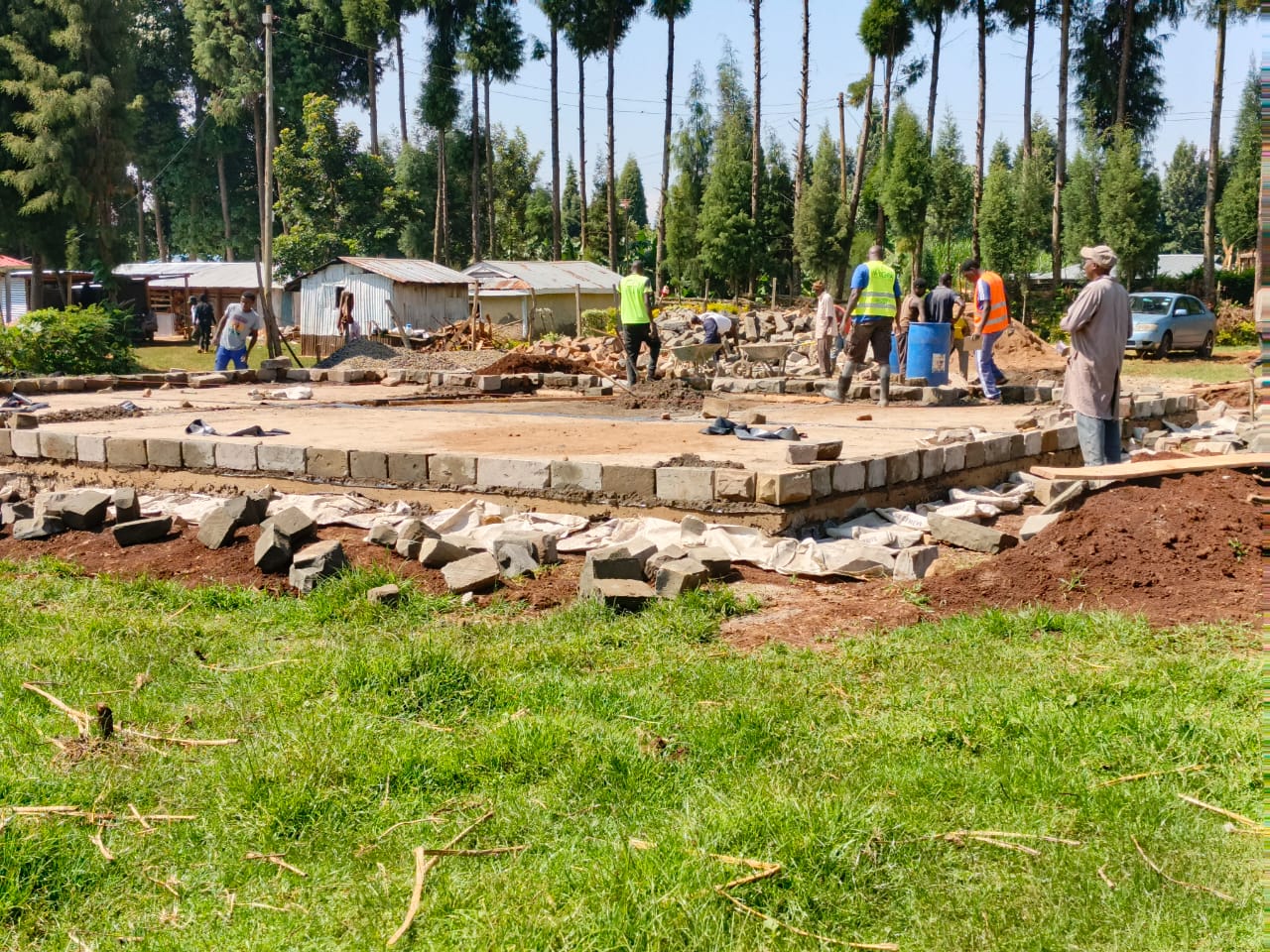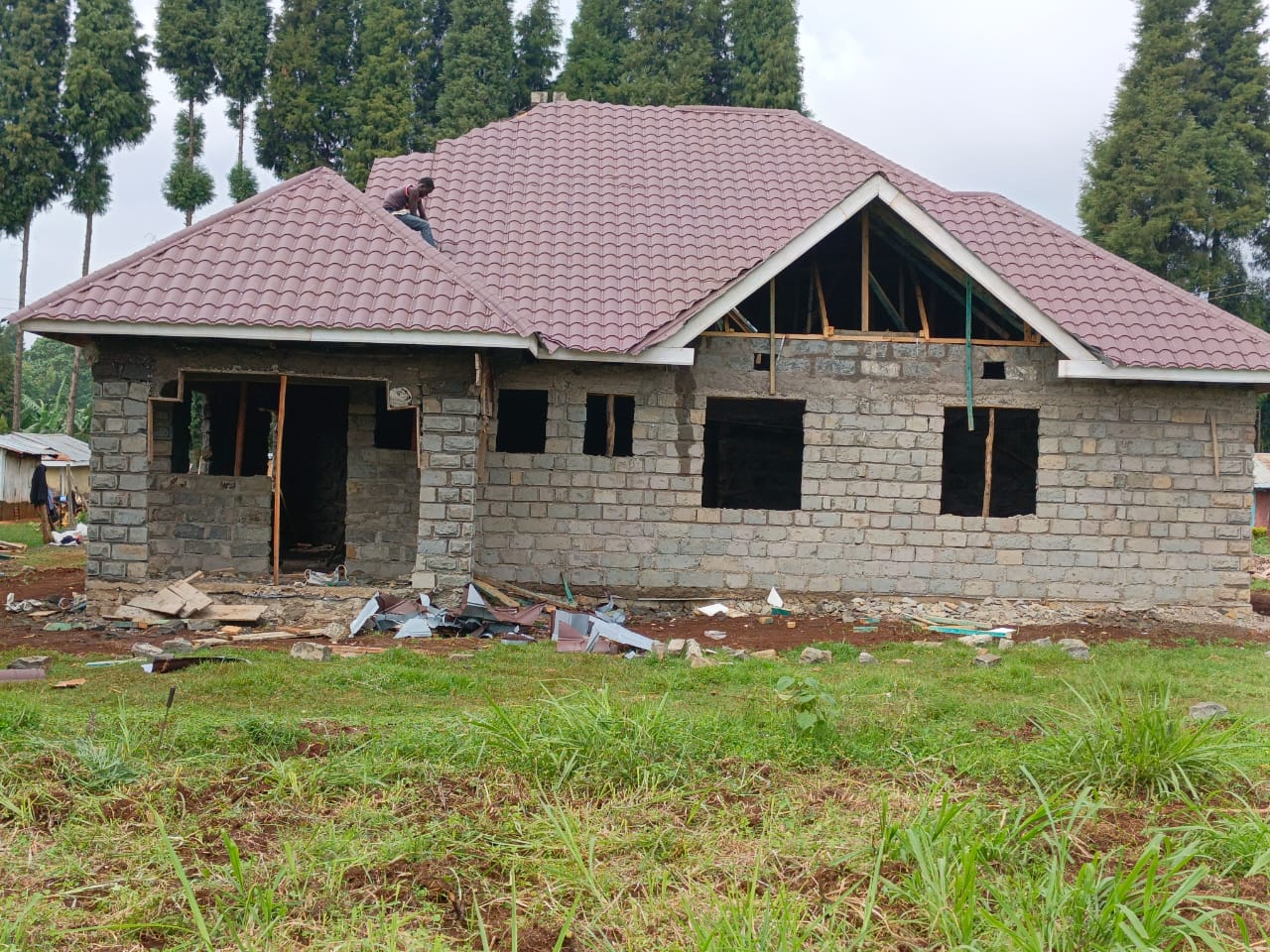
The roofing stage of house construction in Kenya is the point where a building finally becomes a house. Once the roof is on, the walls are protected from rain, plastering and electrical work can start inside, and the project usually speeds up. It is also a stage where small mistakes, such as a weak ring beam, poorly treated timber or a shallow pitch, cause leaks and repairs for years.
This guide follows on from the walling stage in our series on the stages of house construction in Kenya. It explains the order of work, what to inspect at each step, and how to avoid the problems we see most often on site.
Want the real cost of YOUR roof and house? Get a free cost estimate from our quantity surveyor: WhatsApp 0789 217 685
Where the roofing stage fits in the build
A typical house in Kenya goes through these stages: site preparation, foundation, floor slab, walling, ring beam, roofing, then finishing. Roofing should only start when the walls have reached their full height, the ring beam (or the top slab, for a flat roof) has been cast and cured, and the structural engineer’s details for the roof are on site.
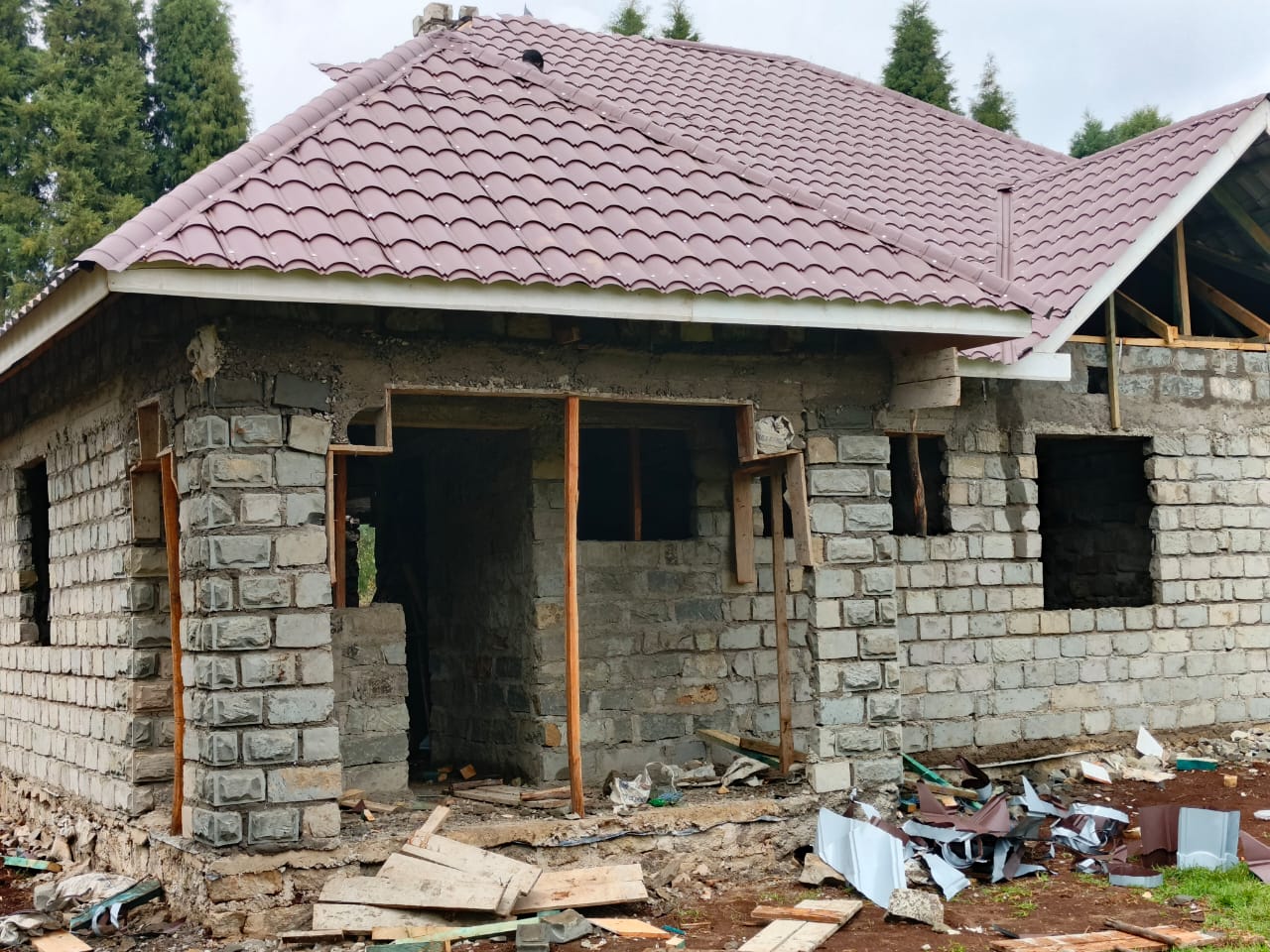
Step-by-step: the roofing stage for a pitched roof
Most bungalows and many maisonettes in Kenya use a pitched roof with timber or steel trusses and iron sheets or tiles. The usual sequence is:
- Ring beam. A reinforced concrete beam cast on top of the walls ties the walls together and gives the roof a firm seat. Holding-down straps or bolts for the wall plate are set into it while the concrete is wet.
- Wall plate. A treated timber plate (or steel member) is fixed along the top of the ring beam with those straps or bolts. It spreads the load of each truss.
- Trusses. Trusses are made to the engineer’s drawings, either on site or in a workshop, then lifted and fixed at the spacing shown on the drawings. They must be plumb, in line and braced.
- Bracing. Diagonal and longitudinal braces stop the trusses from leaning or racking in strong wind. This step is often rushed or skipped.
- Purlins or battens. These run across the trusses and carry the roofing sheets or tiles. Spacing must suit the roofing material chosen.
- Fascia board. The board along the eaves gives a neat edge and carries the gutters.
- Underlay, where specified. An underlay or insulation layer reduces heat and noise, especially under iron sheets.
- Roof covering. Iron sheets, stone-coated sheets or tiles are fixed with the correct overlaps and fixings, starting from the edge away from the prevailing wind.
- Ridges, flashings and valleys. These seal the joints where roof slopes meet or where the roof meets a wall.
- Gutters and downpipes. These carry rainwater away from the walls and foundation, or into a storage tank.
How a flat roof is different
A flat roof is a reinforced concrete slab. The roofing stage then means formwork and props, steel reinforcement as per the structural drawings, casting, curing, and finally waterproofing with a proper fall to outlets. Parapet walls usually hide the slab. A flat roof can later carry a water tank, solar panels or even another floor if it was designed for that load. The 3-bedroom bungalow flat roof drawings (WKRE024) in our shop show a typical flat-roof layout, while the 3-bedroom single-storey house plans (WKRE013) are a useful reference for a pitched-roof bungalow.
To compare iron sheets, stone-coated sheets, tiles and concrete, see our guide to types of roofing materials in Kenya.
How long does the roofing stage take?
It depends on the size and shape of the roof, the material, whether trusses are made on site or in a workshop, the weather, and, for flat roofs, curing time before props are removed. A simple gable roof on a bungalow goes up much faster than a hipped roof with several valleys on a maisonette. Ask your contractor for a written programme that shows each roofing step and its expected duration, and link payments to completed steps rather than to dates.
What about the cost?
The roof is one of the larger items in a house budget, but its share varies with the roof shape, the covering and the span. Our guide to roofing cost in Kenya per square metre explains how to budget for it. For the whole house, Integrum’s 2026 rates put a standard bungalow at about KSh 54,730 per m² in Nairobi and KSh 57,080 per m² in Western and Nyanza. These are indicative planning figures, not quotations. A bill of quantities for your own drawings is the only reliable way to price your roof.
Watch: a house from foundation to finished roof
Roofing stage checklist: what to inspect
- Ring beam cast to the drawings, level, and cured before loading.
- Holding-down straps or bolts at the spacing shown, firmly embedded.
- Timber treated against termites and rot, dry, and of the sizes specified.
- Trusses at the correct spacing, plumb, aligned and fully braced.
- Purlin or batten spacing matching the roofing manufacturer’s guidance.
- Correct roof pitch for the covering; too shallow a pitch lets wind-driven rain in.
- Sheets or tiles with proper overlaps, the right fixings and washers, and no dents.
- Flashings at every wall junction, chimney and valley.
- Gutters with a steady fall and downpipes that discharge away from the foundation.
- For flat roofs: props left in place for the period the engineer specifies, and waterproofing tested before finishes.
Costly roofing mistakes to avoid
- Skipping the ring beam or casting it without enough steel, which leaves the roof poorly anchored.
- Using untreated or wet timber, which twists, shrinks or attracts termites.
- Building trusses “by eye” instead of from engineered drawings.
- Leaving out bracing, so the roof moves in strong wind.
- Buying the thinnest sheets to save money, then repairing dents and leaks.
- Forgetting gutters, so rainwater splashes the walls and soaks the foundation.
- Paying for the whole roof upfront instead of per completed and inspected step.
Regular checks by someone who knows what to look for make a big difference; our guide to construction site inspections explains how to organise them. Whoever builds your roof should be a contractor registered with the National Construction Authority, the body established under the NCA Act No. 41 of 2011 to oversee the construction industry. If you would rather have one team handle design, structure and roof, read about design and build in Kenya.
Questions to ask your contractor before roofing starts
- Do you have the engineer’s truss or slab details, and will you follow them exactly?
- What gauge or thickness of sheet, or which tile, is priced in the BQ?
- How is the timber treated, and can I see it before it is fixed?
- Who inspects the ring beam and trusses before the covering goes on?
- Are gutters, downpipes, fascia and flashings included in the price?
- What warranty do you give on leaks after handover?
Want the real cost of YOUR house, roof included?
Send us your house plan or tell us the number of bedrooms, roof type and location. Our quantity surveyor will give you a free indicative cost estimate, and our team can design and build the whole house for you.
Or call 0789 217 685 / 0724 481 087.